Needs Survey on Students’ Knowledge of Agriculture and Sustainability
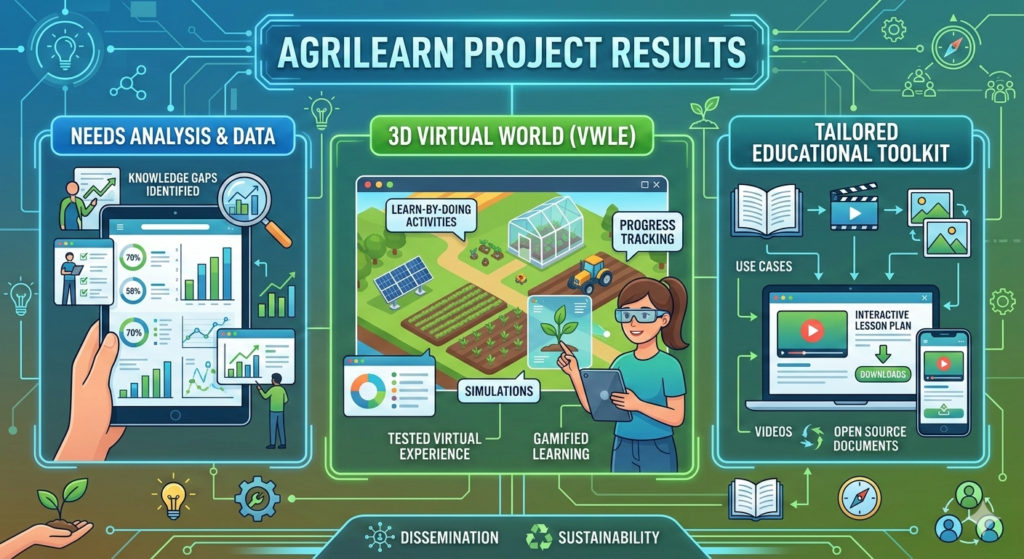
This deliverable presents the results of the initial needs analysis conducted with school students participating in the AGRILEARN project. The survey investigates students’ knowledge, perceptions, and attitudes toward modern agriculture practices and environmental sustainability. The collected data help identify knowledge gaps among the target groups and provide valuable insights into how students understand topics such as sustainable farming, food production, and environmental protection. The survey is conducted across partner schools and associated organisations to ensure that the findings reflect diverse educational contexts across Europe. The resutls of this study form the foundation for the design of the AGRILEARN learning scenarios. By analysing the responses, the project consortium identifies the most relevant topics and thematic areas to be addressed in the digital learning environment. This deliverable ensures that the development of educational materials and virtual world scenarios is directly aligned with the real needs and interests of students. It also supports evidence-based decision-making during the pedagogical design phase of the project.
Analysis of Students’ Knowledge Gaps and Learning Needs
This deliverable provides a comprehensive analysis of the data collected during the AGRILEARN needs survey. The document examines students’ responses to identify patterns in their understanding of agriculture, sustainability practices, and environmental challenges. The analysis highlights differences between participating regions and educational contexts, allowing the consortium to understand how knowledge levels vary across countries and school systems. These insights help determine which topics require stronger educational focus. Based on the findings, the consortium defines a set of recommendations for the development of learning scenarios and digital educational materials. The analysis also outlines key learning objectives and thematic priorities that will guide the design of the AGRILEARN virtual learning environment. This deliverable therefore acts as the bridge between the initial research phase and the development of the educational scenarios that will later be implemented within the 3D virtual world learning platform.
Design of Gamified Educational Use Cases
This deliverable describes the educational scenarios that will be implemented within the AGRILEARN virtual learning environment. The scenarios translate the findings of the needs analysis into engaging learning experiences based on gamification principles. Each scenario addresses a specific topic related to modern agriculture, environmental sustainability, or responsible resource management. The scenarios simulate real-life situations in which students explore agricultural practices, analyse environmental impacts, and make decisions within interactive learning environments. Partners collaborate to design these use cases by combining pedagogical expertise with technological capabilities. The scenarios incorporate storytelling, problem-based learning elements, and interactive tasks that encourage students to actively participate in the learning process. These use cases form the core content of the AGRILEARN platform and will later be integrated into the virtual world learning environment developed in the next phase of the project.
Educational Content and Learning Resources
This deliverable includes the educational materials that accompany the AGRILEARN learning scenarios. The materials provide teachers and students with the necessary theoretical background and instructional resources to support the learning activities implemented in the virtual environment. The deliverable includes two main components: educational resources for teachers and learning materials designed specifically for students. Teacher resources provide guidance on how to integrate the scenarios into classroom activities, while student materials introduce the learning topics and explain the objectives of each scenario. All materials are designed to align with the pedagogical framework established during the analysis phase and are structured to ensure accessibility for learners from different backgrounds and educational systems. These resources ensure that the AGRILEARN digital learning environment is supported by well-structured educational content that promotes critical thinking, collaboration, and active engagement with sustainability topics.
AGRILEARN 3D Virtual World Learning Environment
This deliverable presents the AGRILEARN 3D Virtual World Learning Environment, which serves as the main technological outcome of the project. The platform integrates the educational scenarios and learning materials developed in earlier phases into an interactive digital environment. The development process follows an iterative approach consisting of three major stages: the Alpha version, the Beta version, and the Final version. Each stage introduces improvements based on testing results and feedback from experts, educators, and students. The virtual world allows students to explore simulated agricultural environments, interact with learning scenarios, and experiment with sustainable farming practices in a safe and controlled digital space. This immersive approach enhances engagement and improves knowledge retention. The final platform will be accompanied by demonstration videos, system documentation, and a user manual to ensure that the platform can be easily used, extended, and maintained in the future.
Piloting Activities and Evaluation Report
This deliverable presents the results of the piloting phase, during which the AGRILEARN platform and educational materials are tested in real educational settings. Partner schools implement the learning scenarios in classrooms and collect feedback from students and educators. The piloting phase evaluates the usability, educational effectiveness, and engagement potential of the virtual learning environment. Feedback is gathered through questionnaires, classroom observations, and discussions with participants. The evaluation report analyses the collected data and identifies strengths, challenges, and areas for improvement. The findings are used to refine the platform and learning materials before their final release. Through this process, the project ensures that the developed solutions are practical, effective, and aligned with the needs of the educational community.
Project Dissemination and Multiplier Events
This deliverable documents the dissemination activities carried out during the AGRILEARN project. These activities aim to promote the project results and share knowledge with educators, policymakers, researchers, and other stakeholders across Europe. The dissemination strategy includes multiplier events organised by project partners, presentations at conferences and workshops, publications, and online promotion through the project website and social media channels. These events provide opportunities to present the AGRILEARN virtual learning environment, demonstrate its educational potential, and encourage other organisations to adopt or build upon the project’s results. Through these dissemination efforts, the project seeks to maximise its impact and ensure that the developed tools and methodologies reach a wide audience within the education and sustainability sectors.